What I work on
Research
How the brain learns the structure of the world
My research asks how humans (and in particular babies) build internal models of structured environments: from infants discovering the regularities of their mother tongue, to adults accumulating evidence towards a decision, to the temporal structure that shapes what we perceive. I approach these questions along three complementary strands.
- 01Statistical and network learning in sequences
- 02Decision making and sensory integration
- 03Auditory cortex development and prematurity
Strand 01
Statistical and network learning in sequences
How listeners, even sleeping newborns, extract transition probabilities and the graph structure hidden in streams of sound.
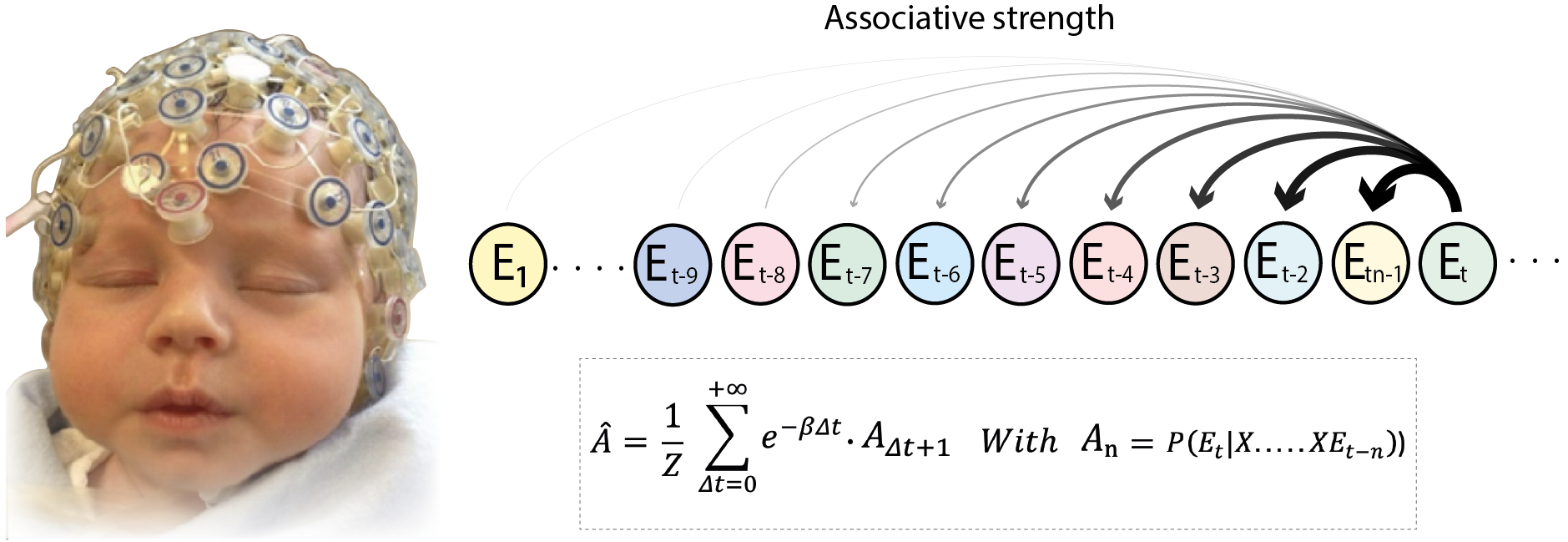
A central question of my PhD: how do humans extract the latent structure of sound sequences? We have shown that sleeping neonates (two or three days old) can learn transition probabilities between syllables and use that information to segment a continuous speech stream (Benjamin et al., Dev. Sci., 2023; Fló et al., Sci. Rep., 2022).
Beyond local transition probabilities, we found that people prune and complete the underlying network structure of the input (Benjamin et al., eLife, 2023), and that long-horizon associative learning unifies local transition-probability learning with high-order graph learning in a single mechanism (Benjamin et al., J. Neurosci., 2024; Benjamin et al., PNAS, 2026).
With colleagues at Aix-Marseille University (J. Pesnot-Lerousseau and B. Morillon) and in Quebec (P. Albouy), I am now using intracranial recordings to resolve the fine-grained neural basis of this learning in humans.
Strand 02
Decision making and sensory integration
How temporal prediction, evidence accumulation and rule discovery interact while the brain commits to a choice.
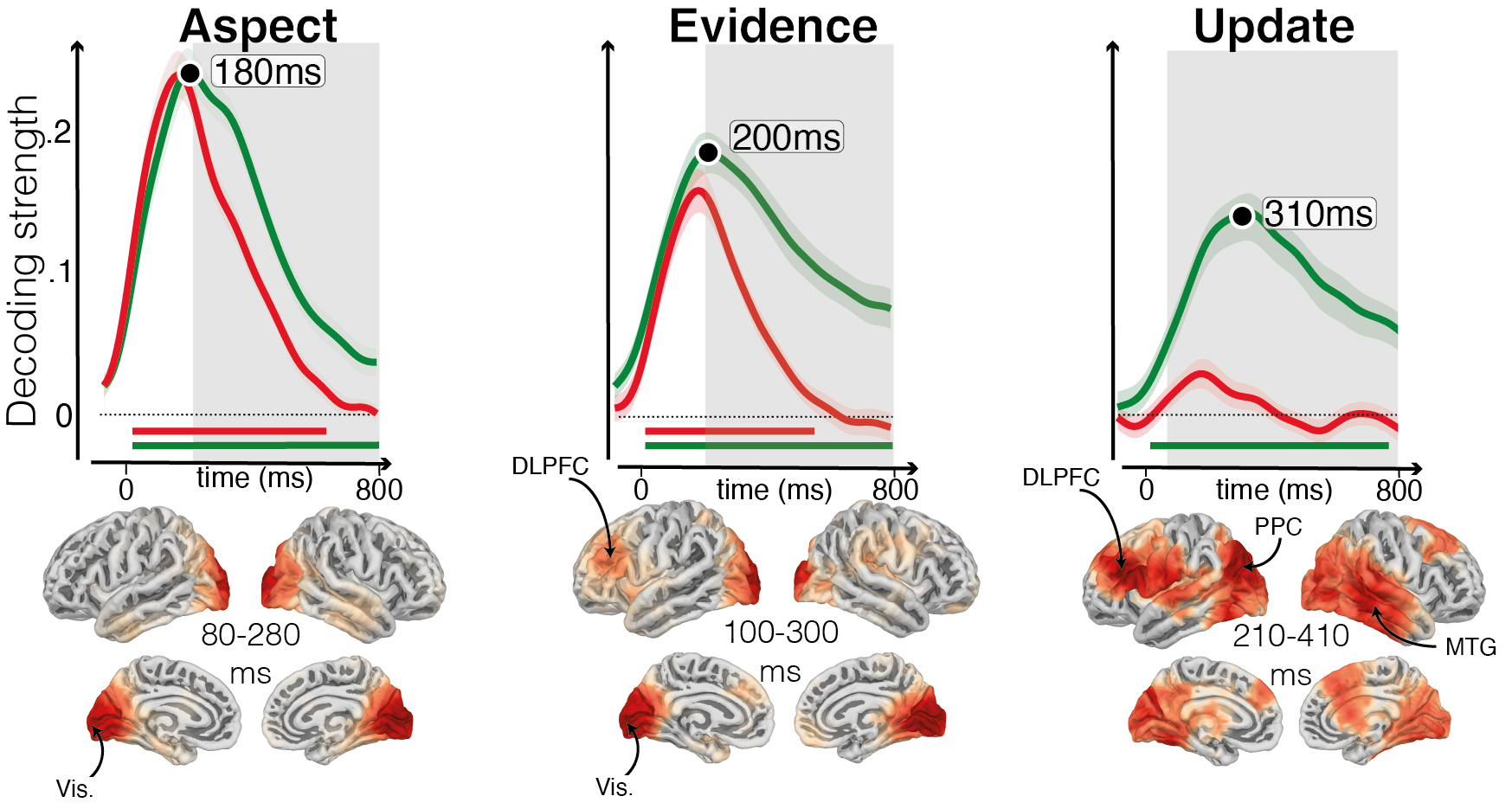
In my postdoc with B. Morillon and V. Wyart, we asked how temporal predictions, sensory integration and rule discovery interact during perceptual decisions, and found them to be interdependent rather than separable inference processes (Benjamin et al., PNAS, 2026).
My current project (work in progress) combines MEG with computational models that bridge Bayesian inference and recurrent neural networks, to investigate the neural basis of flexible evidence accumulation and the role abstraction plays in it.
Strand 03
Auditory cortex development and prematurity
How early auditory experience sculpts the superior temporal sulcus in the newborn brain.
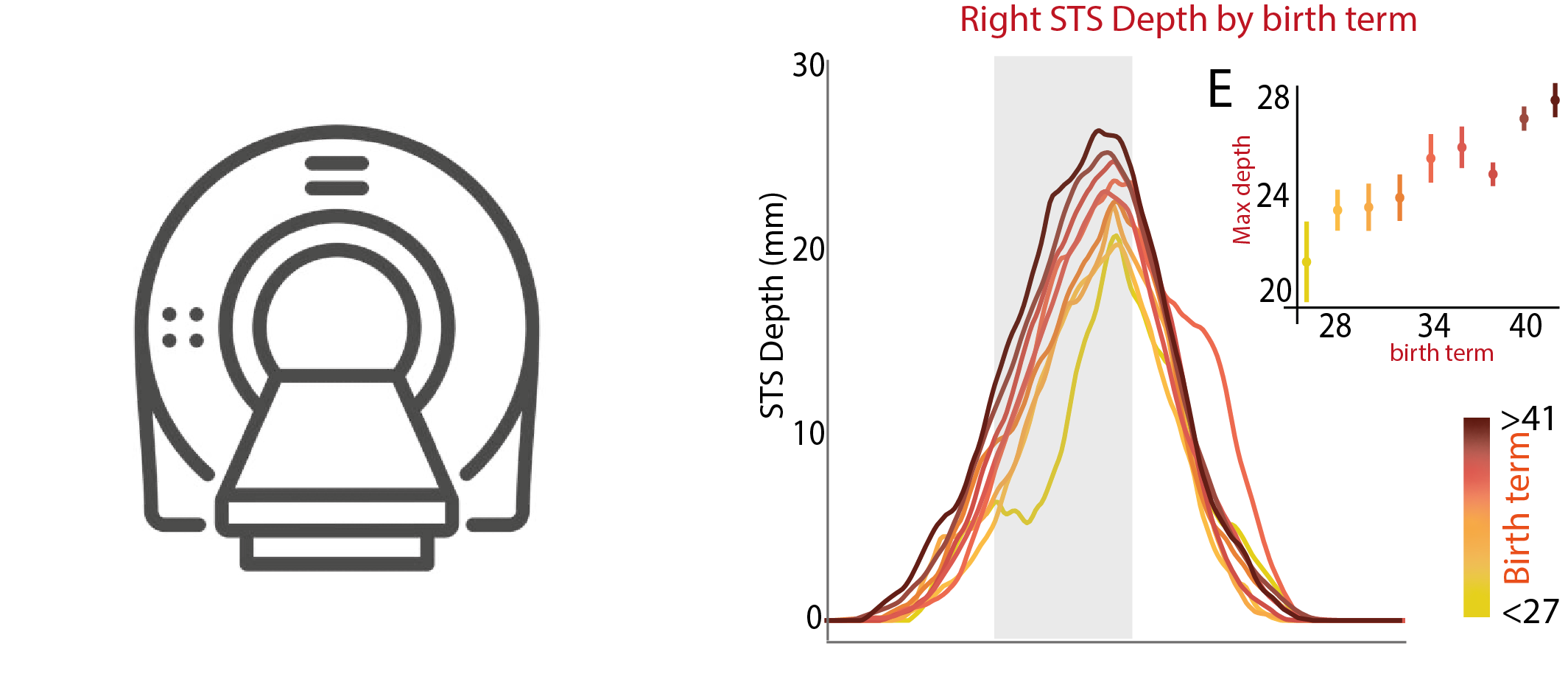
With G. Dehaene-Lambertz and the Geneva neonatal team, we used MRI to study how early auditory experience shapes the structure of the superior temporal sulcus in newborns (Benjamin et al., Brain Struct. Funct., 2025), and how gestational age and sex affect its functional connectivity at term-equivalent age (Mancuso et al., Brain Struct. Funct., 2025).
Toolkit
Methods
Measuring the signal, then explaining it with a model that could have produced it.
- BehaviourPsychophysics and sequence-learning tasks in adults, infants and patients.
- EEG · MEG · iEEGHigh-density recordings, including neonatal EEG and intracranial recordings in epileptic patients.
- MRI · fMRIAnatomical morphometry of the neonatal brain and task-based functional imaging.
- Computational modelsMathematical accounts of behaviour, Bayesian observers, recurrent neural networks.
Path
Background
From signal processing and bio-engineering to the developing brain.
- 2024 → Postdoctoral researcher INS, Aix-Marseille Université (B. Morillon) and LNC², ENS-PSL (V. Wyart). Funded by the Fondation pour la Recherche Médicale.
- 2023 PhD in cognitive neuroscience NeuroSpin (CEA & Sorbonne Université), supervised by Ghislaine Dehaene-Lambertz, on learning temporal dependencies in auditory sequences, in adults and neonates.
- 2018–2019 Research visits University College London (M. Chait, auditory salience and pupillometry) and the Montreal Neurological Institute, McGill (R. Zatorre, P. Albouy, B. Morillon, speech and music processing).
- 2015–2019 Engineering MSc & MSc in computational biology CentraleSupélec, major in bio-engineering and signal processing, with a parallel MSc at Université Paris-Saclay.